
Why Periti

Customer-Outcomes driven

Our focus is on ensuring that your systems, platforms and processes support you in doing business how you want to serve your customers.arrow

HubSpot Centric

Having deep expertise in HubSpot and other core business systems enables us to integrating and customize your tech stack seamlessly..arrow


Building a Bi-Directional Netsuite/HubSpot Integration: A Real World Guide in Three Parts - Part 3

Building a Bi-Directional Netsuite/HubSpot Integration: A Real World Guide in Three Parts - Part 3
10:08
Building a Bi-Directional Netsuite/HubSpot Integration: A Real World Guide in Three Parts - Part 3

From Discovery to Go-Live: Lessons From the Trenches


In Part 1 of our blog series, Building a Bi-Directional NetSuite/HubSpot Integration: A Real-World Guide in 3 Parts, we talked about the discovery and solution design phases of a recent, custom NetSuite/HubSpot integration we completed for a client in the manufacturing industry. In Part 2, we explored how we built the integration using AWS as middleware, navigating complex requirements that no off-the-shelf connector could handle. In our final installment, Part 3, we'll discuss the User Acceptance Testing (UAT) phase, the cutover, and the various lessons we learned along the way.

Some background: This project spanned several months, involved late nights, holiday cutovers, a 147-item UAT tracker, and a few lessons. We worked alongside a NetSuite implementation partner, navigated shifting requirements, and ultimately delivered a system that converts closed-won HubSpot deals into NetSuite sales orders in near real-time, while syncing 30,000+ products nightly.

We're sharing this because the gap between, "how integrations should work in theory," and "what actually happens when you're three days from go-live and someone just added fifteen new UAT items," is vast. If you're considering a similar project, the specific challenges we faced, and how we solved them, might save you significant time and frustration.

This is what it actually looked like...


Part 3: Testing, Cutover, and Lessons Learned


UAT: When Comprehensive Testing Pays Off

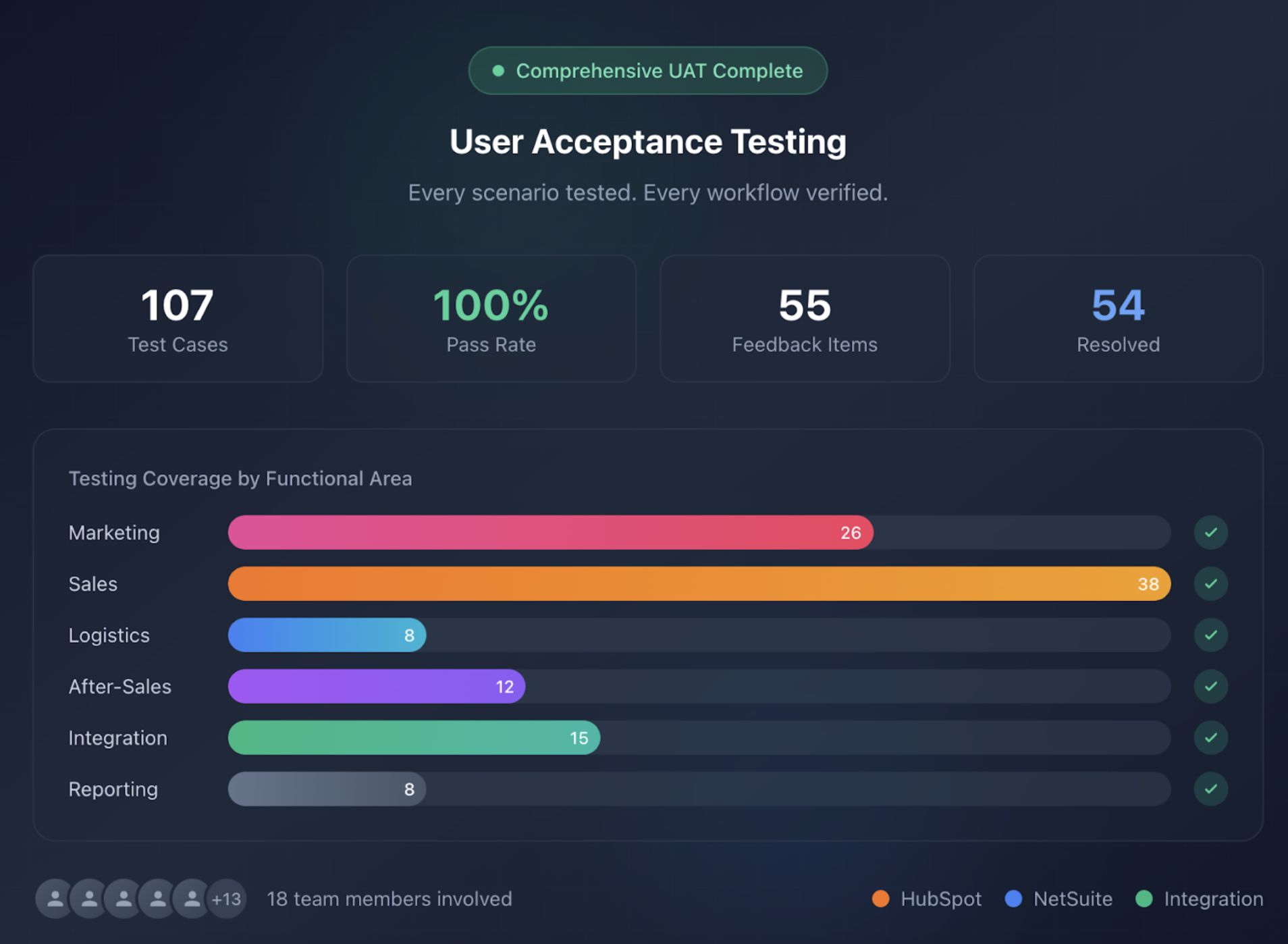
We went through extensive User Acceptance Testing with a tickbox list of 147 UAT items. It was thorough, methodical, and exactly what a project of this complexity needed.

Having a dedicated UAT tracker meant nothing slipped through the cracks. Every sync scenario, every edge case with the address logic, every workflow trigger — it all got tested and verified. The project manager ran a tight process, and the client's team was engaged and responsive, flagging issues quickly and providing clear feedback.

The rigour of that UAT phase is a big part of why the integration was stable from day one. When you're dealing with real-time deal-to-sales-order conversion and nightly syncs of tens of thousands of products, you can't afford to skip steps. We didn't.


Screenshot 2026-02-09 at 9.59.25 AM

 
The Cutover Period: Making It Work Over the Holidays

The cutover was scheduled over the Christmas holidays. Not ideal timing, but the client had business imperatives that made it necessary. So we made it work.

The team adjusted holiday plans, coordinated across time zones, and executed the cutover between the 29th and 31st. Data imports took place. The integration went live on January 2nd as planned, with a few minor issues spotted and resolved in real-time.

It required early mornings, close coordination, and a lot of flexibility from everyone involved, including our team, the client, and the NetSuite partner. But that's what it takes sometimes. When the business needs to hit the ground running in the new year, you find a way to get it done. And we did.


Working With Implementation Partners

The NetSuite implementation partner was invaluable throughout this project. They were responsive, knowledgeable, and understood what we needed from the NetSuite side to make the integration work. When you're building a bi-directional integration, having a counterpart on the other system who knows what they're doing makes everything easier.

Regular alignment meetings between the HubSpot team and NetSuite team prevented misunderstandings and kept both sides synchronised on data formats, API requirements, and expected behaviours.

 
What We'd Refine Next Time

Every project teaches you something. This one reinforced a few things we'll carry forward:

  • Get complex relational logic documented early. The address logic was genuinely complicated: several companies per deal, each with multiple address types. We ultimately solved it elegantly with association labels, but getting alignment that worked for users and systems took work. On future projects with similar complexity, this is something we’ll have in our back pocket.

  • Treat mapping documents as living artifacts with precise version control. A shared spreadsheet works great for collaboration, but adding formal checkpoints ensures everyone's working from the same complete picture.

  • Keep UAT focused by category. The 147-item tracker was comprehensive and valuable — and we'd replicate that thoroughness again. Separating integration testing from general CRM feedback just helps keep things organised.

What Worked Exceptionally Well
  • Cross-team collaboration made the impossible possible. HubSpot team, NetSuite partner, and the company's internal stakeholders all worked together to enable a genuinely complex integration.

  • Automated logging and email summaries gave everyone visibility into system health without requiring technical expertise to interpret.

  • The custom quote templates transformed a tedious manual process into a seamless one. Sales reps could generate professional, perfectly formatted quotes directly from HubSpot without copying data into Word documents or worrying about version control. It sounds simple, but removing that friction made a real difference to their daily workflow.

  • Having a single technical owner for the integration — someone who understood both the HubSpot side and the AWS middleware inside and out — meant decisions could be made quickly. There was no ambiguity about who to ask or who could fix something. That clarity kept the project moving even when things got complicated.

  • Finally, the client's team deserves credit. They knew what they wanted, they were responsive when we needed input, and they trusted us to solve complex problems. A project like this only works when both sides are genuinely invested in the outcome. They were.


Final Thoughts: It's a Marathon, Not a Sprint


Building a custom bi-directional integration between NetSuite and HubSpot is a substantial undertaking. It requires a deep understanding of both platforms, careful planning, and patient execution.

But when it works, when a sales rep closes a deal in HubSpot and minutes later the operations team sees a perfectly formed sales order in NetSuite with all the right customer associations and address configurations, it's worth it. When the nightly sync runs at 2 AM and everyone wakes up to current inventory and credit data, it's worth it.

Plan thoroughly, document everything, work with good partners, and remember that the goal isn't just technical success. It's enabling people to do their jobs better without fighting their tools.

If you're ready to discuss a HubSpot/NetSuite integration with a set of seasoned experts, please reach out to Periti Digital today!


Frequently Asked Questions

Q: How long does a bi-directional NetSuite-HubSpot integration typically take?

A: A comprehensive bi-directional integration is a substantial undertaking that requires careful planning and patient execution. Based on this project, expect several months from scoping through to go-live. The timeline includes discovery and mapping, custom middleware development, extensive UAT (in this case, 147 test items), and a coordinated cutover period. The complexity of your specific requirements, such as multi-company address logic or real-time deal conversion, will influence the duration.


Q: What's the most challenging aspect of this type of integration?

A: Complex relational logic—particularly when dealing with multiple entities that need to sync across systems. In this project, the address logic was genuinely complicated: several companies per deal, each with multiple address types that needed to map correctly to NetSuite. Getting alignment that worked for both users and systems took careful planning. We solved it elegantly using HubSpot association labels, but it required deep understanding of both platforms and close collaboration with the NetSuite implementation partner.


Q: How important is User Acceptance Testing for an integration like this?

A: Absolutely critical. We went through 147 UAT items, testing every sync scenario, edge case, and workflow trigger. This thoroughness is why the integration was stable from day one. When you're dealing with real-time conversions and nightly syncs of tens of thousands of products, you can't afford to skip steps. A dedicated UAT tracker ensures nothing slips through the cracks and gives both teams confidence that the system works as expected before go-live.


Q: Can you implement this type of integration during normal business operations?

A: Yes, but the cutover period requires careful coordination. In this case, the go-live happened over the Christmas holidays due to business imperatives. Not ideal timing, but manageable with the right planning. The key is having flexibility from all parties (internal teams, HubSpot specialists, and NetSuite partners), clear communication across time zones, and the ability to resolve issues in real-time. With proper preparation and a comprehensive UAT phase beforehand, the actual cutover can be executed smoothly even during challenging timeframes.


Q: What should I look for when choosing partners for this type of project?

A: Three things matter most: expertise in both platforms, strong collaboration skills, and clear ownership. Your NetSuite implementation partner needs to understand API requirements and data formats as well as their HubSpot counterparts do. Regular alignment meetings between teams prevent misunderstandings. Finally, having a single technical owner who understands both the HubSpot side and the middleware inside-out means decisions get made quickly without ambiguity. The best projects happen when all parties—your team, the HubSpot specialists, and the NetSuite partner—are genuinely invested in the outcome.